


Wine from Umbria
Wine from Umbria
Umbrian wines: in the heart of the mountains
Introduction
Mountainous, landlocked and lacustrine, whose name seems (coincidentally) evocative of the shadows, Umbria is the ancient middle-point of the peninsula, the definition of the centre, known – after a line of Carducci – as ‘the green heart of Italy’. Home to the towns of Perugia and Orvieto, and Assisi, to the latter’s great saint Francis, to beautiful lakes and rivers, to some of Italy’s best sausages and perhaps the whole of Europe’s best lentils. A verdant, foggy, snow-capped dream of a region.
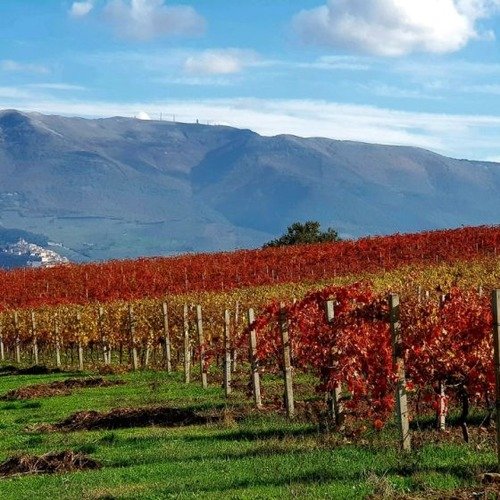
Sandwiched between Tuscany, Lazio and Le Marche, Umbria is one of only three regions in Italy not to have a coastline. Instead, it is home to a stretch of the Apennine mountains, and its lowest point is still a good 100m above sea level, while its highest, the peak of Monte Vettore, is nearly 2,500m! The Tiber flows through it, cutting one of the two valleys that stretch across the region, along with the Umbrian valley (Val Tiberina and Valle Umbra, respectively). It is a truly dramatic climate, the most concentratedly elevated of anywhere in the country bar the Val d’Aosta – which, naturally, has a strong effect on its oenology!
The wine
There are two DOCG-level wines in the region, both of which are red and both of which are profoundly affected by the extra-high altitudes. First, in the province of Perugia, Torgiano Rosso Riserva DOCG is a fascinating wine, a sangiovese-based blend that’s one of the highest-elevation examples of its kind around. It is distinguished by several other factors, too: for one thing the complexity of its blend, with sangiovese mandated to make up no less than 50% but no more than 70%, canaiolo minimum 15% and maximum 30%, the white trebbiano up to 10%, and other red grapes like ciliegiolo up to 15%; for another thing the length of ageing required to hit the riserva mark, a full three and a half years in total at least, comparable to thee very highest level of Chianti. The wines are famously long-lived, rewarding patience in the cellar, with more on the red fruit than the black fruit side of the ledger, as well as an ability to take a hint of good brettanomyces (i.e. smoky, leathery notes).
Second, a really unique Umbrian original. Still in the province of Perugia, but on the other side of the city from Torgiano, around the village of Montefalco grows a very unusual grape known by the name sagrantino. This grape has a particular superpower: while other grapes might be high in acidity but low in polyphenols (i.e. tannins), or high in polyphenols but with moderate ester content (i.e. fruitiness), or any combination of the above, sagrantino is just maximally everything. A monster of a grape, a hugeness of hugeness, full of fruit, flowers, freshness and, above all, tannins (tests show it to be even more tannic than the Madiran grape, whose name, tannat, is literally derived from its polyphenolic bigness – that’s how much tannin we’re talking here). Sagrantino di Montefalco DOCG is a varietal wine, made 100% of its extrovert eponymous variety. It must be aged for 37 months prior to release, at least a year of which must be in oak barrels – in practice, it is usually much more. The resulting wine is, naturally, enormous, structured beyond imagination and never with an alcohol by volume less than 15%. But it is also zinging and potent in its acidity and dense and dark in flavour; it can age for decades, after which it is known for developing exotic and distinctive flavours like kale, carbon and tobacco. It’s really quite something.
The DOCG also extends to the area’s dessert wine, made by the passito method of fermenting from semi-raisins. There’s no obligation to age the wine in barrel (though it frequently is), and the rampant polyphenols, while balanced out by the sugar, give this wine a very particular grip and bittersweet element.
Montefalco Rosso DOC is a different creature altogether, however. Instead of being based on sagrantino, the DOC is based on sangiovese to a maximum of 70%, with some sagrantino (and others) allowed in the blend. As a result the wine is much softer and early-drinking friendly, though with a little of the claws and brooding character of its bigger brother.
Perhaps the most surprising red of the region, however, is the pinot noir (or pinot nero in Italian) made in the Lago di Corbara DOC, around the man-made lake of Corbara. Both a regular and a Riserva are available under the DOC, which generally makes impressively pale, agile wines with plenty of vim and zest. It’s probably the closest thing in Europe to the famous pinot noir of Santa Barbara, California – a cool climate wine in a hot region thanks to fog and altitude.
On the white side of things the best-known is surely the Orvieto DOC, mentioned in The Count of Monte Cristo as particularly worthy of the attention of the epicure. A minimum of 40% of the wine must be from the signature white grape of Umbria, grechetto, whose thick skin and full ripening makes for remarkably bold and sapid wines (Orvieto is usually a balanced blend, with especially trebbiano – known locally as procanico – acting as a lighter, fresher partner). Umbria has become a great home for cutting-edge wine styles such as ‘orange’ wines (i.e. white wines vinified on their skins like reds), and the pachydermatous nature of grechetto makes it particularly suited to producing especially firm examples.
And of dessert wines? Well, we have mentioned the passito in passing, but Umbria is also (thanks to its characteristic topography) home to an IGT known as ‘Muffato’ or ‘mouldy’ – which may not sound immediately delicious, but that is in fact a reference to the manner of its making, via the ‘noble rot’ (or botrytis, to get clinical about it) that is also responsible for the famous and magnificent dessert wines of Sauternes, among others. One of the Sauternes grapes, sauvignon blanc, is used in Umbria, but it is given more oomph and punch by the ever-present grechetto, to produce one of the most fascinating and beguiling – not to mention underrated – sweet wines going.
Umbria, Italy’s green heart, land of peaks, lakes, fields and shadows. Land of wines whose rough and sinewy strength are really there to act as scaffolding for the most ethereal and dreamy subtleties and finenesses, wines whose apparent maximal power is in fact a buttress for their incomparable depths. It has perhaps been an overlooked region at times; more and more, this is proving less and less the case.
Our wines from Umbria
A selection of the wines from Umbria we sell in our Venice wine shop and ship internationally.


Umbria – The breakdown
Location: centre of centre.
Climate: cool continental.
Soils: calcareous, limestone, calcrete (a rare natural almost-concrete).
Elevation: very considerable.
DOCGs, selected DOCs and an IGT: Montefalco Sagrantino DOCG, Torgiano Rosso Riserva DOCG; Assisi DOC, Colli Martani DOC, Colli Perugini DOC, Lago di Corbara DOC, Montefalco DOC, Orvieto DOC, Spoleto DOC; Muffato di Umbria IGT.
Main red grapes: pinot nero, sagrantino, sangiovese.
Main white grapes: grechetto, pinot grigio, sauvignon blanc, trebbiano (procanico).
Hidden gem: the light, acrobatic pinot nero wines of Lago di Corbara are really worth seeking out.
About Wine Shop all’Amarone


Wine Shop all’Amarone in Venice offers an exceptional selection of Italian wines, spotlighting the distinguished Amarone della Valpolicella. In addition to our Amarone focus, we proudly feature select wines from Lombardy, showcasing the diversity and richness of Italy’s winemaking regions. Our curated collection is designed to offer wine lovers a taste of Italy’s finest, from the robust flavors of Amarone to the unique profiles of Lombardy wines.

