


From One Tasting to the Next: Cheeses and Wines of Veneto
Wine and cheese are often paired by habit. This article looks at them as a sequence instead: how texture, aging, and structure change the role of the wine at the table. Starting from Veneto, it outlines a tasting path built through observation, adjustment, and repeated comparison.
Pairing wine and cheese: a few simple rules
When pairing wine and cheese, it’s tempting to search for a fixed rule. In practice, a small set of clear ideas is enough to navigate confidently—especially if you think of pairing as a balance between cleansing, supporting, and carrying the finish.
1) Balance of intensity (neither should overpower the other)
Wine and cheese need comparable strength. A delicate cheese with a powerful wine disappears; a very aged cheese can make a light wine feel thin.
2) Fat calls for something that cuts
Many cheeses coat the palate. Acidity and, when present, effervescence reset the mouth and keep the tasting focused.
3) Salt and umami: structure and length
As cheeses age, savory depth and persistence increase. Wines need structure and length to keep pace, not necessarily more alcohol.
4) Tannins: mind the edges
Tannins work best when integrated and when the cheese has enough structure to absorb them.
5) Blue cheeses: contrast
With blue cheeses, contrast often works best—measured sweetness with acidity, or sparkling wines that refresh the palate.
For those who wish to explore the tasting principles behind these pairing choices, in Italy, the sensory evaluation of cheese follows a well-established analytical approach.
ONAF – Organizzazione Nazionale Assaggiatori Formaggi has long promoted a method based on
texture, aroma, balance, and persistence—key elements when assessing how cheese interacts with wine at the table.
For readers interested in a deeper look at this tasting framework, ONAF offers a valuable point of reference.

How to taste cheese
Cheese tasting benefits from a simple, methodical approach. Texture comes first, then flavor, then persistence. We recommend starting from the center of the paste and moving outward, so the palate can register changes in firmness, aroma, and salt.
When present and edible, cheeses are served with their rind. The rind is part of the cheese’s identity: it reflects aging conditions, microbial activity, and often adds bitterness, earthiness, or aromatic depth. Tasting paste and rind together gives a more complete picture and helps the wine interact with all components of the cheese, not just its core.
With these ideas in mind, what follows is a practical map: a Venetofocused concept built through repeated tastings, small adjustments, and choices guided by the palate.


The proposed pairings
Below are the pairings we are currently working on—not as a fixed scheme, but as a snapshot of an ongoing process that keeps wine at the center and uses cheese as its measure. Each cheese has been chosen for its texture, aging, and flavor profile, so that every step changes the way the palate reacts to the wine.
1. Alpine Butter & Custoza – Monte del Frà
Cheese
Produced in Alpine areas using highquality cream from mountain dairies, this butter reflects a coldclimate dairy tradition focused on purity rather than excess richness. The texture is dense yet immediately melting, with sweet cream aromas, fresh milk notes, and very low acidity.
Wine
Custoza – Monte del Frà | Veneto, hills south of Lake Garda.
A blendbased white typical of the Custoza area, marked by floral notes, citrus zest, gentle herbal hints, and a subtle saline finish. Medium body, moderate alcohol, and clean acidity.
Why it works: Custoza’s freshness and light salinity clear the palate, setting a neutral and precise starting point for the tasting.
2. Fresh Goat Cheese & Soave – Inama
Cheese
Made from fresh goat’s milk, typically in smallscale farms, this cheese is consumed very young. It shows bright lactic aromas, natural acidity, a slightly tangy profile, and a soft, spreadable texture with a clean, direct finish.
Wine
Soave – Inama | Veneto, volcanic hills of Soave Classico.
Based on Garganega, this Soave shows citrus fruit, green apple, almond, and a distinct mineral backbone linked to volcanic soils. High acidity and a linear, focused profile.
Why it works: The wine mirrors the cheese’s freshness while adding definition and mineral tension.
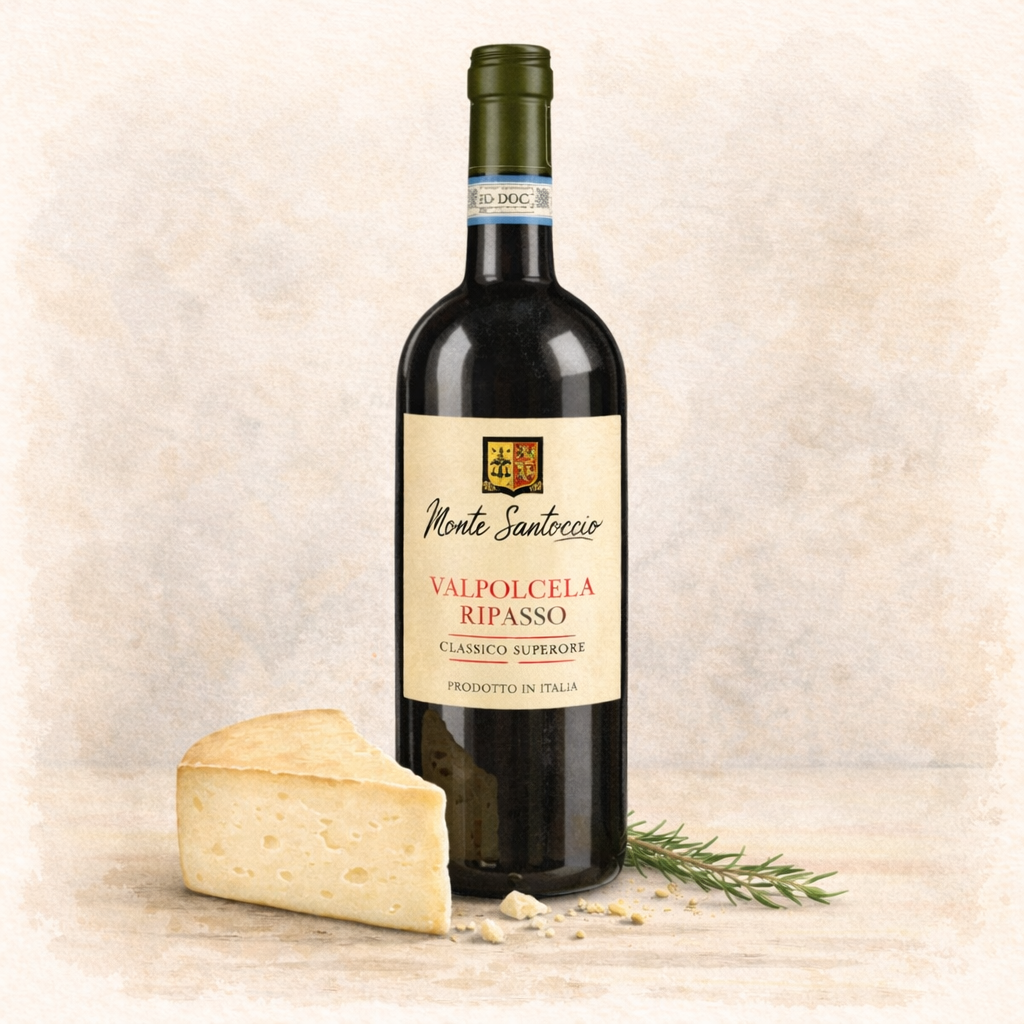
3. Soft Cow’s Milk Cheese & Valpolicella Ripasso – Monte Santoccio
Cheese
A fresh cow’s milk cheese typical of northern Italian dairy traditions, made to be eaten young. The paste is soft and elastic, with aromas of fresh milk and yogurt, low acidity, and a gently sweet profile.
Wine
Valpolicella Ripasso – Monte Santoccio | Veneto, Valpolicella.
Produced using the ripasso technique, this wine offers ripe red fruit, subtle spice, moderate alcohol, and soft, integrated tannins. Medium body with roundness rather than power.
Why it works: The wine’s warmth and round texture support the cheese’s creaminess without overwhelming it.
Wine in our eshop: Valpolicella Ripasso – Monte Santoccio
4. SemiAged Alpine Cheese & Valpolicella Superiore “Prognai” – Ilatium
Cheese
Produced in the Lessinia mountains, north of Verona, this style is closely associated with Monte Veronese, one of Veneto’s most representative alpine cheeses. Made from cow’s milk and aged for several months, it moves from fresh dairy notes toward cooked butter, hay, and gentle savory tones. The texture becomes firmer while maintaining balance and clarity.
If you are in the area: Monte Veronese can be found in small mountain dairies in Lessinia, at local caseifici, and in wellcurated cheese shops in Verona and its surroundings. Asking for the aging level (mezzano vs vecchio) is often more important than the specific producer.
Wine
Valpolicella Superiore “Prognai” – Ilatium | Veneto, Valpolicella.
A Valpolicella with extended aging and higher structure, showing red cherry, dried herbs, subtle spice, and vibrant acidity. Medium body with controlled tannins.
Why it works: The wine’s structure and acidity give shape to the cheese’s evolving complexity.
Wine in our eshop: Valpolicella Superiore “Prognai” – Ilatium
5. WineAged Cheese & Valpolicella Ripasso “Il Vegro” – Brigaldara
Cheese
A cheese aged in wine or grape skins, a traditional technique that adds color, tannic hints, and vinous aromas. The paste remains compact, balancing savory and lightly bitter notes with residual sweetness.
Wine
Valpolicella Ripasso “Il Vegro” – Brigaldara | Veneto, Valpolicella.
Layered and smooth, with dark cherry, dried fruit, spice, and wellintegrated tannins. The ripasso process adds depth without excess weight.
Why it works: Ripasso extends the wine character already present in the cheese, creating continuity without redundancy.
Wine in our eshop: Valpolicella Ripasso “Il Vegro” – Brigaldara
6. Aged Alpine Cheese & Amarone della Valpolicella – Corte Canella
Cheese
A longaged mountain cheese, again closely linked to the Monte Veronese Vecchio tradition when produced in Veneto. Aging extends well beyond a year, leading to a firm paste, visible protein crystals, pronounced umami, and long savory persistence.
If you are in the area: Look for Monte Veronese Vecchio in mountain dairies in Lessinia, specialty cheese shops in Verona, or at producers focusing on long aging. Texture and aroma are key indicators of quality.
Wine
Amarone della Valpolicella – Corte Canella | Veneto, Valpolicella.
Fullbodied and dry, with dried cherry, spice, cocoa, and firm but balanced tannins. High extract and long finish, yet controlled in alcohol expression.
Why it works: Amarone provides depth and length that can keep pace with the cheese’s intensity.
Wine in our eshop: Amarone della Valpolicella – Corte Canella
7. Blue Cheese Aged with Raboso & Amarone Riserva “Due Mori” – Ilatium
Cheese
A blue cheese with controlled mold development, further shaped by aging with Raboso wine. Salinity, aromatic intensity, and structure are pronounced but balanced.
Wine
Amarone Riserva “Due Mori” – Ilatium | Veneto, Valpolicella.
Deep and composed, with dried fruit, spice, and tightly integrated alcohol. Less overt sweetness, more focus on structure and length.
Why it works: The wine’s restraint and depth match the cheese without relying solely on sweetness.
Wine in our eshop: Amarone Riserva “Due Mori” – Ilatium
8. Very Aged Blue / Buffalo Blue & Franciacorta “Animante Riserva” – Barone Pizzini
Cheese
Extremely aged blue cheeses, including buffalo milk versions, show sharp salinity, dense texture, and very long persistence. The flavor profile is intense and dominating.
Wine
Franciacorta “Animante Riserva” – Barone Pizzini | Lombardy, Franciacorta.
Traditional method sparkling wine with extended aging on lees. Creamy mousse, fine bubbles, complex aromas of bread crust and citrus, and strong mineral tension.
Why it works: The wine’s verticality and effervescence refresh the palate and restore balance at the end of the tasting.


Reading the pairings as a whole
At All’Amarone, menus change through small shifts rather than abrupt turns. They come from repeated tastings, bottles put to the test, and combinations that prove convincing over time.
Over recent months, we’ve been working on a possible tasting path dedicated to Veneto—not as a declaration, but as an exercise in balance. Wines and cheeses are placed side by side to understand where the dialogue becomes clearer, more fluid, and more convincing.
What precedes is not the announcement of a new menu, but the outline of an idea taking shape: a way of thinking about sequence, contrast, and progression, one tasting at a time.
Mountain cheeses vs. lowland cheeses: a quick lens
A helpful way to read this pairing path is to think about where the cheeses come from. Mountain and prealpine cheeses tend to develop firmer textures, clearer savory notes, and longer persistence—often linked to pasturebased milk and longer aging. Lowland cheeses more often highlight softness, milk sweetness, and immediacy.
In Veneto, that contrast shows up clearly in cheeses such as Monte Veronese (semiaged to longaged), which brings umami and length and calls for wines with structure or vertical lift. On the other side, fresh cow’s milk and goat’s milk cheeses—meant to be enjoyed young—work naturally with whites and sparkling wines that lean on acidity and clarity.
This is a simple distinction, but it shapes the whole tasting—and it’s a topic worth expanding on in a future post.
The wines: freshness, tension, depth
Veneto wines offer a range of styles that extends well beyond its most familiar expre ssions. In this path, precise whites sit alongside reds focused on finesse rather than force, with sparkling wines playing an active role in shaping the palate.
We begin with wines such as Custoza from Monte del Frà—floral, citrusdriven, and gently savory. A wine that prepares the palate without weighing it down, working through restraint rather than display.
Soave, appearing at several points, comes into play when more definition is needed: acidity, almond notes, and a mineral backbone that works naturally with fresh, lactic cheeses.
The selected Valpolicella wines avoid excess. Even in Ripasso and Superiore styles, the focus remains on drinkability, clean fruit, and the ability to accompany rather than dominate. Amarone appears only when the cheese truly requires it—as a response to umami and long aging, never as a display of strength.
Sparkling wines play a central role. Lessini Durello and Franciacorta are not substitutes but tools: they restore momentum, interrupt heaviness, and prevent the palate fatigue that can result from overly rich pairings.
Sweet wines are used sparingly—not to finish on sweetness, but to restore balance with extreme cheeses, where salt and intensity demand a precise counterpoint.
This is a simple distinction, but it shapes the whole tasting—and it’s a topic worth expanding on in a future post.

Pairing is not about addition
An intense cheese plus an intense wine doesn’t automatically result in a good match. Often, the outcome is palate saturation.
For this reason, the path alternates between harmony and contrast: structured whites with wineaged cheeses, mature sparkling wines with rich cheeses, sweetness supported by acidity with blue cheeses. Each choice comes from tasting, not from abstract rules.
The decision to exclude dry red wines in the final stage follows the same logic: when a cheese’s persistence is extreme, only verticality or balanced sweetness can stay in dialogue.
Your turn
Which pairing draws your attention the most? Which would you be curious to try at the table—or which feels the boldest?
Share your thoughts on our social channels. Your feedback will help guide the next steps of a path that is still evolving.
A new menu takes shape through many tastings shared over time.

